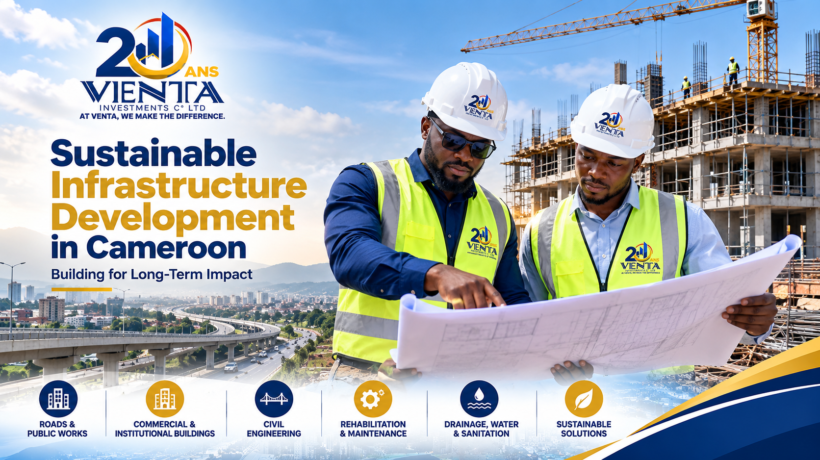
Sustainable Infrastructure Development in Cameroon: Building for Long-Term Impact
Infrastructure shapes how communities live, businesses operate and economies grow. Roads connect people to markets and services. Schools create spaces for learning. Healthcare facilities support healthier communities, while commercial and public buildings provide the physical foundation for economic and institutional activity.
But infrastructure delivers its greatest value when it is built to last.
For Cameroon, sustainable infrastructure development is therefore about more than completing construction projects. It requires careful planning, quality execution, appropriate materials, responsible resource use and long-term maintenance.
As infrastructure needs continue to evolve, governments, businesses, institutions and development organizations need solutions that respond to today’s requirements without creating unnecessary costs and challenges for tomorrow.
Through its Infrastructure, Construction & Public Works division, VENTA Investments Company Limited supports this approach by delivering infrastructure solutions with an emphasis on quality, professionalism, resilience and long-term value.
What Is Sustainable Infrastructure Development?
Sustainable infrastructure development involves planning, constructing and maintaining infrastructure in ways that consider its economic, environmental and social impact throughout its useful life.
In practical terms, a project should not be judged only by how quickly a structure can be completed. Decision-makers also need to consider how well it will perform, how it will be maintained, whether it responds to local conditions and whether the investment will continue delivering value over time.
This applies to buildings, roads, drainage systems, water and sanitation infrastructure, rehabilitation works and other public or commercial facilities.
In Cameroon, where infrastructure must perform under varied climatic, geographic and operational conditions, these considerations are particularly important.
A sustainable project begins with a simple question: Will this infrastructure continue serving its intended purpose effectively years after construction is completed?
Why Sustainable Infrastructure Matters in Cameroon
Infrastructure projects require significant financial, material and human resources. When a project deteriorates prematurely, the impact extends beyond repair costs.
Businesses can experience operational disruption. Public institutions may struggle to deliver services. Communities can lose reliable access to important facilities, while governments and organizations may have to allocate additional resources to repairs that could have been reduced through better planning and preventive maintenance.
This is why sustainable infrastructure development in Cameroon should consider the complete lifecycle of a project.
The objective is not simply to construct more. It is to construct intelligently, maintain consistently and ensure that infrastructure remains functional for the people and institutions that depend on it.
Quality Construction Is the Foundation of Long-Term Performance
Sustainability starts with quality.
Good design can lose its value when construction standards are poorly implemented. Similarly, quality materials cannot compensate for inadequate planning or weak project supervision.
A successful infrastructure project requires coordination between design, materials, workmanship, site conditions, project management and quality control.
For institutional and commercial clients, this means choosing a construction company in Cameroon that understands the wider purpose of the project rather than focusing only on physical construction.
At VENTA, infrastructure development forms part of an integrated service approach covering buildings, roads, civil engineering, rehabilitation, maintenance, drainage, water and sanitation infrastructure, and institutional projects.
This allows infrastructure requirements to be considered within the broader operational needs of the client.
Building Infrastructure That Responds to Local Conditions
Sustainable construction should reflect the environment in which a project will operate.
Cameroon’s regions present different conditions, including variations in rainfall, terrain, urban density and infrastructure access. A solution appropriate for one location may require modification in another.
Drainage provides a clear example.
A road, compound or commercial property can be well constructed but still experience problems if water management is inadequate. Poor drainage can contribute to erosion, flooding, structural deterioration and accessibility problems.
Considering drainage and water movement during planning is therefore not an optional addition. It can directly influence the long-term performance of infrastructure.
The same principle applies to material selection, site preparation, access, maintenance requirements and the intended use of a facility.
Rehabilitation Can Be as Important as New Construction
Sustainable infrastructure does not always mean building something new.
Existing buildings, roads and facilities often represent substantial investments that can continue delivering value when properly rehabilitated and maintained.
Before replacing infrastructure, organizations should assess its current condition and determine whether rehabilitation can restore functionality, improve safety or extend its service life.
This approach can be particularly valuable for public institutions, commercial facilities and organizations operating existing property portfolios.
Professional rehabilitation may include structural improvements, repairs, modernization of specific components and improvements that make a facility more suitable for current operational requirements.
The key is to base the decision on a proper assessment rather than assuming that replacement is always the better option.
Preventive Maintenance Protects Infrastructure Investment
Construction is only the beginning of an infrastructure asset’s life.
Once a building or facility becomes operational, exposure to weather, daily use, equipment movement and normal wear gradually affects its condition.
Small defects that are ignored can eventually become larger and more expensive problems.
Preventive maintenance helps organizations identify these issues earlier. Regular inspection and planned intervention can reduce unexpected breakdowns, protect structural and functional components, and support longer asset life.
For organizations investing in infrastructure development in Cameroon, maintenance should therefore be considered during the planning stage—not introduced only after deterioration becomes visible.
This shift from reactive repairs to planned maintenance can improve both operational continuity and long-term value.
Sustainable Infrastructure Supports Stronger Institutions
Infrastructure and institutional performance are closely connected.
A hospital needs dependable facilities to provide healthcare effectively. Schools need safe and functional learning environments. Businesses require buildings, access roads and supporting infrastructure that allow employees and customers to move efficiently.
Government institutions and development organizations similarly depend on infrastructure to deliver programmes and public services.
When infrastructure works as intended, it often goes unnoticed. When it fails, the consequences can affect almost every part of an organization’s operations.
For this reason, sustainable infrastructure development should be viewed not only as a construction objective but also as an investment in institutional resilience.
Environmental Responsibility in Infrastructure Projects
Construction inevitably interacts with the surrounding environment.
A responsible approach seeks to manage this interaction carefully through appropriate site planning, material use, waste management, drainage considerations and environmental protection measures relevant to the project.
Sustainability does not require every project to use the newest or most expensive technology. Practical improvements in planning, construction methods, resource management and maintenance can also make a meaningful difference.
The goal is to balance infrastructure requirements with responsible implementation and long-term performance.
At VENTA, sustainability and responsible operations are cross-cutting principles, connecting infrastructure development with environmental services, facility management and broader institutional solutions.
Choosing an Infrastructure Development Partner in Cameroon
Selecting an infrastructure partner should involve more than comparing construction quotations.
Organizations should consider the contractor’s understanding of the project, technical capability, approach to quality, safety practices, project coordination and capacity to support the infrastructure beyond initial construction.
Before appointing a provider, decision-makers should consider questions such as:
- Does the company understand the project’s long-term purpose?
- Can it manage construction, rehabilitation and maintenance requirements?
- Does it understand local operating conditions?
- How does it approach quality control and project coordination?
- Can it work effectively with institutional and project stakeholders?
- Does it consider sustainability throughout project implementation?
These questions help shift procurement discussions from the lowest immediate cost toward long-term value.
Handling Mounting And Unmounting Of Given Navigation Routes In React Native
Johnny M. Martin
VENTA’s Approach to Infrastructure, Construction & Public Works
VENTA Investments Company Limited approaches infrastructure as part of a wider commitment to building stronger and more resilient institutions.
Its Infrastructure, Construction & Public Works capabilities include buildings, roads, civil engineering, rehabilitation, maintenance, drainage, water and sanitation infrastructure, and institutional projects.
This multidisciplinary approach is particularly relevant for governments, businesses, NGOs, development organizations and international partners seeking a local implementation partner capable of understanding both infrastructure delivery and the operational environment surrounding a project.
VENTA’s wider service portfolio also enables infrastructure projects to connect with facility management, environmental services, logistics, smart technologies and institutional support where required.
Building Today With Tomorrow in Mind
Cameroon’s infrastructure needs will continue to evolve alongside urban growth, economic development and changing institutional requirements.
Meeting those needs requires more than increasing the number of projects delivered. It requires infrastructure that remains useful, maintainable and resilient over time.
For project owners, this means thinking beyond the construction phase. Design decisions, quality execution, drainage, environmental considerations, rehabilitation and preventive maintenance all influence whether today’s investment continues delivering value tomorrow.
That is the real purpose of sustainable infrastructure development in Cameroon: creating infrastructure that serves people and institutions today while remaining valuable for the years ahead.
Planning an infrastructure, construction, rehabilitation or public works project?
Talk to VENTA Investments Company Limited.
Explore Our Solutions | Request a Proposal | Partnership Enquiry
At VENTA, We Make The Difference.


